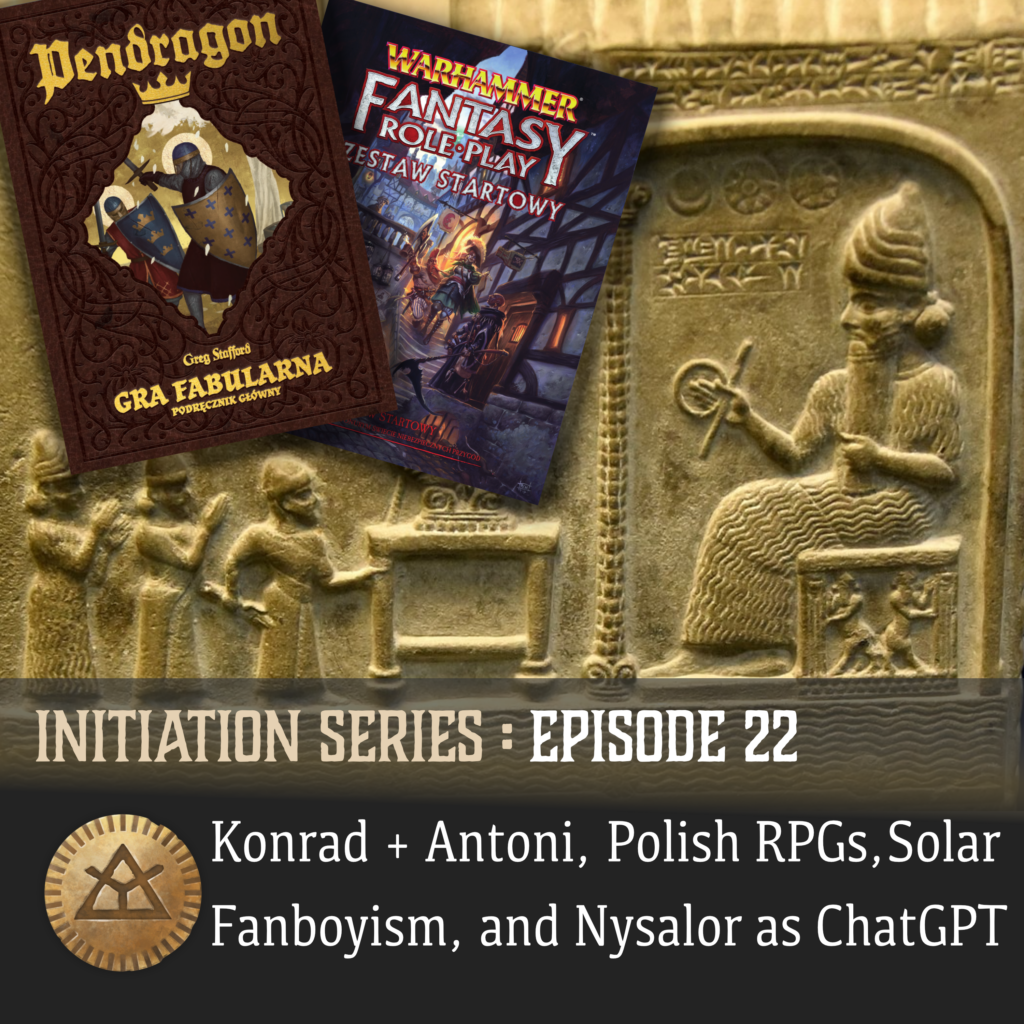
For this new Glorantha Initiation interview, we have two guests, which explains the unusual length of this episode… we welcome Antoni and Konrad!

  • Konrad studies Bronze Age history, does LARPs, and runs games for teens and children. He has been running RPGs for about 11 years, and RQG for 4 years. You can catch him on Discord as @SpellcastingKisiel
  • Antoni studies geography. You can find him on Facebook as Antek Bartoszko.

Show Notes

  • Antoni introduces himself:
    • Started RPGs with D&D 3e in high school. Then Warhammer 2e, which is “the most patriotic Polish RPG”. Gothic is the most patriotic Polish computer game.
    • Antoni has opinions about the “drama kids” school of RPG and modern games.
    • He’s a novice GM, and has more fun as a player.
    • Recent games Antoni likes are Fabula Ultima (a TTRPG inspired by JRPG video games) and Vaesen (a Scandinavian 19th-century folk-horror TTRPG).
    • Apparently Antoni broke Vaesen with min-maxing!
  • Konrad introduces himself:
    • He discovered RPGs in a summer camp, watching kids playing Warhammer 2e… but they never let him play! Booo!
    • The following year he started playing and GMing, notably a post-apocalyptic Polish game.
    • Konrad feels more comfortable as a GM, and likes faction play.
  • Warhammer is very very popular in Poland!
  • Poland didn’t have any particular printing of any RPG at first, so people smuggled hastily translated rulebooks. Warhammer was a good fit. It was one of the very first officially released RPGs in Poland.
  • Then, the only Polish RPG magazine at the time broke everyone’s mind about Warhammer because everyone was pretty much taking Warhammer at face value, instead of the comedic game it’s supposed to be. The pun names weren’t translated!
  • Antoni got Konrad into Glorantha.
    • He discovered Glorantha with King of Dragon Pass through a video game streamer playing it.
    • He loved the cultures and vibrant world.
    • He later discovered that there was an RPG, but was turned off by the “realistic combat” that RuneQuest boasted about having.
    • After playing Six Ages, Antoni started ranting to Konrad about Glorantha.
  • We talk a bit about heroquesting as Antoni misunderstands a question about HeroQuest/QuestWorlds as an alternative system with no “realistic combat” in it. Since these books weren’t really available in Poland, it wasn’t on his radar.
  • Konrad realized that he tried playing Six Ages, as he was interested in bronze age gaming, but didn’t get very far. So when Antoni mentioned Glorantha, he was vaguely familiar with it. He had heard about RuneQuest as a “classic RPG”.
  • Konrad started researching the setting and realized he loves it.
  • Glorantha has “hard worldbuilding”.
  • Konrad likes granular mechanics, so RuneQuest’s system looked good. He also appreciates that he can make his own subsystems easily.
  • Konrad still hopes to run a “proper long campaign” soon.
  • Glorantha is “doing good work” about representing the clan, tribal, city state, and god king mindset that might look alien to a modern reader. It’s not a “historic documentary” game, but it’s a “good approximation”.
  • Glorantha might help later understanding real history.
  • Konrad specializes in Levantine late bronze age (15th to 12th century BCE). He’s also interested in European bronze age. He studies social dynamics, people living outside of temple/city-state systems, etc.
  • Joerg on the other hand started looking into European bronze age first, and didn’t look into the fertile crescent until later.
  • Ludo got into Glorantha first, and then looked into Earth history later.
  • Konrad loved the lore and the societies that “feel alive”. There’s a lot to play with when you’re a GM who loves faction play. He notes how Jonstown is described in the Starter Set, and how it contains multiple groups with multiple motivations and agendas, interwoven with their religious beliefs.
  • In RuneQuest, even the monsters are people.
  • Ludo talks about subsystems for political negotiations, as his players are trying to take over the Alone Confederation.
  • Konrad likes the RQG sorcery rules!
  • Joerg says sorcery is like shamanism: you need to min-max a lot to be useful.
  • Konrad doesn’t seem very interested in shamanism, whereas Ludo thinks it’s one of the unique interesting features of the game.
  • “There are now 7 RuneQuest players in Poland!”
  • Konrad tries to run RuneQuest at every convention in Poland, and in the summer-camps he’s working at… basically trying to kick-start a Polish fandom for RuneQuest.
  • The reception of RQG in Polish conventions seems pretty good. Most players are new to RuneQuest as far as Konrad can tell.
  • Chaosium fans in Poland know and play Call of Cthulhu, which Antoni suspect is the biggest TTRPG in the country right now. Or at least one of the “Holy Trio” (CoC, WFRP, D&D 5e)
  • When Ludo asks if Pendragon is known in Poland, Antoni explodes with laughter. He can’t believe anybody would play this game.
  • There is a Polish edition of Pendragon, which Konrad claims is better-looking than the English one. So Polish people know about the game, and the Polish editor released the translation almost at the same time as the original version.
  • Ludo says that Pendragon is probably not played that much in the grand scheme of things, and probably not in the “top 20 games”, but Joerg ask the rhetorical question of what “top 20” means anyway? (I probably meant “top 20” in terms of number of players)
  • Antoni says that, just like Mage: The Ascension, Pendragon, to him, is more meant to be read than to be played. Ludo mentions he played Mage in his youth, having been a big World of Darkness fan back then.
  • Ludo’s first couple TTRPG purchases were Cyberpunk 2020 and Vampire: The Masquerade, which Konrad says are “very Polish tastes”.
  • Ludo asks Antoni what he doesn’t like about Glorantha. Antoni talks about the various “phases” he had with Glorantha.
  • He mentions the “Dukaj-Stafford” effect (from Jacek Dukaj and Greg Stafford… Dukaj is a Polish science-fiction and fantasy writer). This is when a settings is so good that it makes you give up trying to expand it, because you can’t make anything half as good.
  • Antoni’s “second phase” was discovering the Mongoose RuneQuest books, and the cool aspects of gaming in other places and times in Glorantha.
  • Antoni’s Glorantha will definitely vary, and he wants to give a shout-out to Nick Brooke for enabling that. Antoni’s Dara Happans are cool and awesome, and he has hot takes about them.
  • Antoni talks about the different scopes and takes on Glorantha between the editions, or between the TTRPGs and the video games.
  • Konrad agrees, especially since he discovered Glorantha with Six Ages, so “his boys” are the Solar people.
  • Konrad appreciates “well written barbarian cultures” in Glorantha, but he is more interested in the various types of Solar cultures, or about Orlanthi people in Peloria (“solarized Sartarites!”)
  • Konrad has strong opinions about Elmal vs Yelmalio! He doesn’t buy the “wide scale replacement” of one cult by the other, and gives his reasons for it.
  • Antoni doesn’t really like some of the Gloranthan authors’ approach of pretending that they are “translating” some “actual” Gloranthan texts, instead of just writing a game book.
  • Ludo talks about HeroQuest/QuestWorlds as the thing Antoni and Konrad may look into as they mentioned having trouble doing “bigger things” in RuneQuest.
  • Konrad mentions his “biggest issue” with RuneQuest: how the game and the world are presented. Gloranthan and RuneQuest are “absurdly hard to get into”.
  • The best way to get into this game is “finding a GM”. Konrad says that getting into it by yourself is much harder.
  • Konrad mentions the video games (King of Dragon Pass, Six Ages, RuneQuest Warlords ) as good first steps but admits they are niche games and not for everyone. He’s looking forward to the first official Gloranthan novel (A Pyre for Gods and Heroes).
  • We play the game of “what gets released next year?” Joerg is rather optimistic about it. Ludo is pessimistic… and probably right, since this interview was recorded 6 months ago and nothing Joerg has mentioned seems to be happening soon.
  • Antoni mentions that Konrad often compared Glorantha to the Elder Scrolls video game series… and so he argues Gloranthan needs a Skyrim-like game. No biggie.
  • Ludo mentions The One Ring TTRPG (second edition), trying to make a point about games introducing deep lore to players, and once again the guests immediately laugh. Konrad and Antoni apparently have both very strong, and very opposed, opinions about it.
    • Antoni doesn’t like TOR 2e because of its default place and time.
    • But he likes the progression from easy to hard between The Hobbit, The Lord of the Rings, and the Silmarillion.
    • “With Glorantha, you start with the Silmarillion”.
  • Konrad agrees about that, and mentions how even the RuneQuest Starter Set floods the reader with too much information. How much information is needed to start? Probably a lot less than what the Starter Set gives.
    • Konrad thinks the Starter Set has a good setting and adventures, but not a good presentation of the setting.
  • Antoni gives praise to the fan community, especially the Glorantha groups on Facebook. He also praises the “Prince of Sartar” webcomic as an entry point into the setting.
  • Antoni ask why there’s not Malkioni-Solar syncretism, when there is Malkioni-Orlanthi syncretism that exists?
    • Joerg explains it with the timelines of when Greg Stafford and Jamie Revell were working on this or that across Glorantha.
    • Jamie’s books are available on the Jonstown Compendium. But these books offer an old vision of Malkioni society that isn’t “canon” anymore, for whatever that’s worth.
  • Antoni asks if the Moon Rune existed before the Red Moon appeared?
    • Joerg says the Moon Rune isn’t needed for being a mystic or achieving some kind of transcendence.
    • Joerg also argues the Moon Rune always existed. Ludo has a different take, about the Moon Rune having mostly disappeared at the Dawn, and the Seven Mothers having brought it back.
  • Antoni asks why the Lunars didn’t share the fate of the God Learners.
  • Konrad has many conspiracy theories. For instance: Orlanth can’t read. Also: Nysalor is basically the ChatGPT of Glorantha. You have to listen but his arguments are pretty sound. Joerg even adds another layer…
  • Going back to Malkioni-Solar syncretism, Ludo and Joerg add more ideas.
  • Antoni asks what’s the deal with reincarnation?
    • Ludo had totally missed that there was reincarnation in Glorantha in the first place… we argue a bit about it, and what that means for talking to ancestors.
    • Then we argue some more about interpreting some of the writings, until we end up on the Ty Kora Tek cult write-up, which Ludo says is bullshit, agreeing with Antoni.
  • Antoni’s favourite conspiracy theory is about the role of Brithos in the rebirth of the world in Time.
    • Joerg says “Brithos might have been the backup”. And it makes Zzabur a bit more right.
    • We start gushing about Zzabur and entertaining he is.
  • Konrad hopes to be able to publish some RuneQuest books in the next couple years.
  • We finish with a round of quick-fire questions! Including Konrad’s surprising take on Newtlings!

Credits

The intro music is “Dancing Tiger” by Damscray. The outro music is “Islam Dream” by Serge Quadrado. Other audio is from the FreeSound library.

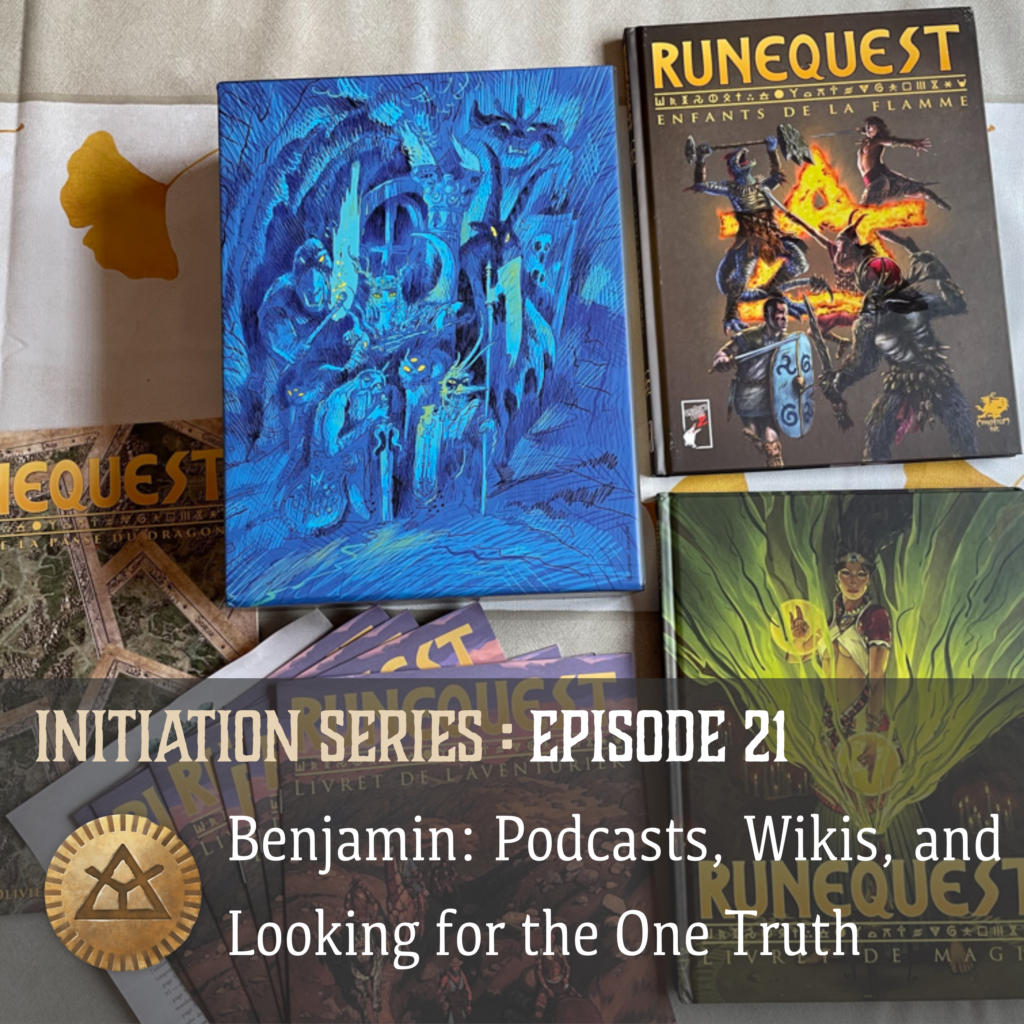
We are back with a long overdue Glorantha Initiation interview featuring twice the amount of French accents! We talked to Benjamin, aka Dasfynx, who is the webmaster of the (French) RuneQuest Wiki, and co-hosts the (also French) “Runecast” podcast with Gianni Vacca.

Continue reading →

Guests

Our guests for this new episode of the Glorantha Initiation series are Christian and Amber, from DMs After Dark! We chatted with them back in… (checks notes) November 2023! How time flies… you can find DMs After Dark in many places around the internet, including:

Amber has written a few things, including some short story in the Monstrous Feminine anthology, and can be found at the West Warwick Public Library where she curates the gaming collection.

Christian has written and published several scenarios, including “Zennor & The Sins of St Senara” and “The Night Mother’s Moon“, for Call of Cthulhu, published by Stygian Fox.

Show Notes

In this episode we talk about, more or less:

  • Luring Amber with promises of playing a werewolf (Telmori)
  • Using Chalana Arroy for luring in the cleric-loving player, and shamans for the player who likes weird characters
  • Animism, the Spirit World, and other gameplay elements that are fairly unique to Glorantha
  • Starting with the Starter Set, then going to the Sourcebook
  • Pacing actual play games, making it feel like sitting at an actual table
  • RuneQuest grognards coming to help with the rules
  • Christian has a “book problem”… Ludo can relate
  • Using Six Seasons in Sartar as a way to start small and get all the PCs together
  • Collaborative storytelling and world-building
  • Reconciling player-created lore with “canon” lore
  • Being mindful of players and the audience when preparing storylines, especially cult initiations leading into mythologies like the Unholy Trio, the Sex Pit, etc.
  • Amber acting as a GM assistant, especially in the early stages of preparation
  • Ludo mentions his short story about Chalana Arroy and Mallia
  • Ducks! Broos!
  • Verisimilitude and/or realism to the Bronze Age and other antiquity history
  • Approaching sensitive topics, and doing editorial work with players to match their comfort levels
  • Casino Town! Cwim! The Crimson Bat! What makes sense in your Glorantha, and what seems out of place
  • Early RQ2 dungeon crawling vs later RQ2 dungeons with ecologies and mythologies
  • Understand the vibe of the system over the rules of the system
  • Mary Renault’s The King Must Die and The Bull From The Sea, as good sources for getting a grasp on the antiquity
  • RuneQuest’s crunchy combat system, with its many moving parts and possible combinations
  • A wild mention of Shadows of Esteren makes Ludo happy!
  • Telmori lore! Of course we mention Brian Duguid’s Children of Hykim (see also our interview episode with Brian)

Credits

The photo of the red deer used in the title image is by Michael Brace.

The intro music is “Dancing Tiger” by Damscray. The outro music is “Islam Dream” by Serge Quadrado. Other audio is from the FreeSound library.

Photo by David Dunham

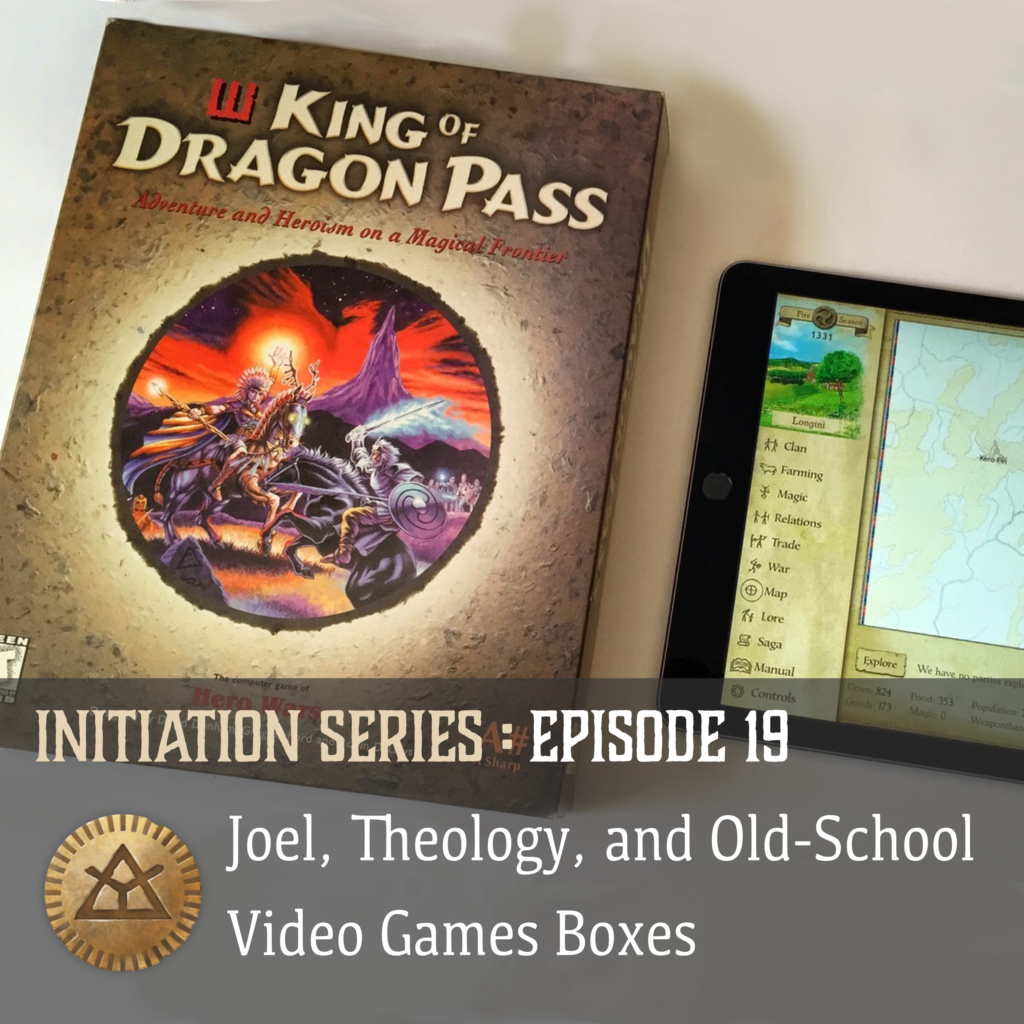
This time we interview Gloranthan newcomer Joel Bridge, who thinks we’re intimidating but also nice! Joel is originally from New Jersey but currently lives in San Diego. You can find Joel on Discord as @sirjamesfriendofthecolonel, and also sometimes on the Glorantha-related subreddits r/Glorantha and r/RuneQuest.

Continue reading →

For this new initiation series episode we are happy to welcome Aaron King!

Show Notes

Things we discuss in this episode include:

  • Minnesota being the “real birthplace of RPGs” (since that’s where Dave Arnison is from), and not Wisconsin (where Gary Gygax lived).
  • Reading Dragon Magazine and figuring out how RPGs work from that.
  • Playing D&D 3.5 and 4.0, and then moving on directly to full-on narrative games like Fiasco, Polaris, Firefly (and the Cortex system), Powered by the Apocalypse games, and more.
  • Discovering Glorantha with King of Dragon Pass and loving the setting, with its faction play.
  • Reading RQ2 Classic… but Aaron thought it was missing something, like it was referencing things the reader didn’t know.
  • Finding a copy of HeroWars, which Aaron felt was “more accessible”.
  • Treating the Big Rubble as Fortnite.
  • Getting some Second Age books from the old Mongoose RuneQuest line, and also the newer RuneQuest Glorantha rulebook.
  • A lot of players are put off by the size of Glorantha, and expectations of “homework” don’t help. See also: how the Marvel Cinematic Universe now “forces” you to watch many other movies and TV series to follow what’s going on.
  • Trying to simplify Glorantha to just “you are part of a clan”. Introducing elements one by one from there.
  • Aaron loves ducks in comics, and loves ducks in Glorantha.
  • Aaron runs his campaign using SpeedRune, a free rules-lite system that he wrote. It’s inspired by Sledgehammer, a simplified version of Warhammer FRPG, and Cybermetal 2012. Player rules are on the character sheet, like in PbtA games.
  • The appeal of seasonal games, like Pendragon and Sagas of the Icelanders, and the passage of time with PCs becoming old and having kids. This lets players make decisions on a grander scale of time.
  • Expansions to SpeedRune are coming (some of them having been released since we recorded), including more Runes, and a non-Gloranthan expansion that lets you play in a campy ancient world setting inspired by the classic Xena/Hercules TV series.
  • Speedrune is easily hacked, and able to bring material from other bronze age fantasy sources besides Glorantha.
  • In SpeedRune, the GM never rolls. The D100 roll defines success, but also one dice is used for damage and the other for “fate”. Combat is pretty quick, but healing is not as easy as in RQG so there’s a slow decline over a season, inciting the player to go in downtime. Because rolls are all player-facing, there is not sitting around while the GM rolls attacks and parries and damage and location for each of the 8 orcs attacking the players.
  • The community gets a character sheet like in Blades in the Dark or HeroQuest Glorantha, which is used during downtime actions.
  • Building your clan and finding a campaign framework.
  • Being a “Glorantha varies extremist”. Aaron starts very small. He lets the players build their community and participate in the world-building, at least a few days’ travel around of the adventurers’ home. The Lunar Empire probably exists but Aaron also wants to include other fun things like Tanith Lee’s “ancient horny demon kings that come at night”.
  • Aaron likes the Second Age books from the Mongoose RuneQuest line written by Robin Laws. He especially likes the idea of the magic religious pyramid scheme that the Empire of the Wyrms Friends setup.
  • Using Glorantha as a big sandbox of cool ideas rather than as canon… possibly because it’s still all new. Aaron has encyclopedic knowledge of other settings like the Elder Scrolls, so it’s not a universal approach. And it probably also explains why Aaron got hooked with Glorantha, since a lot of it has influenced the world of the Elder Scrolls via people like Ken Rolston.
  • One crazy element from Aaron’s Glorantha: an Iron God had its heart pulled out by a jealous dirt god. The heart was grabbed by a goose that was flying by, and it bled over the ground, leaving veins of iron in the ground. Where the goose dropped the heart is a large crater with a big giant metal heart in it, which some people try to exploit and guard jealously.
  • Heroquesting as a reversal of roles between GM and player. Aaron says that “Heroquesting seems difficult” (ho ho ha ha). In SpeedRune, Aaron has the GM roll, and the players not, which is a total reversal of the usual mechanics. In fact, during Heroquests, the GM has to roll above the player skills, like a mirror reality. Aaron isn’t super happy yet about it however, and might tweak it further.
  • One PC in Aaron’s game seems to have ascended as a star.
  • Aaron like the multiple points of view of the people of Glorantha.
  • Having a world reference outside of the mechanics. Aaron has good hopes about the (since then released) Cults of RuneQuest Prosopaedia. However, we also recommend the Glorantha Sourcebook to him, and maybe Trollpak since he likes trolls.
  • We briefly talk about the very old RQ2 Source Pack books with several pages of stats. We also talk about Balastor’s Barracks and its nonsensical dungeon. We even talk about old horrible comicbooks drawn by Rob Liefield.
  • Aaron reiterates his love for the Robin Laws/ Second Age books…. and even possibly recommends the main one as a first contact with Glorantha!
  • There’s a trope of “ancient amazing empires long gone” in fantasy settings, and sometimes you do want to play in those times. If these were indeed amazing times, maybe that should be when and where games should be set! And these old MRQ books allow for that.
  • The main MRQ Second Age book also provides information in a contained way, in one book, whereas a lot of Glorantha information is usually spread across many other books in other product lines. This Second Age book might also show the weirdness of Glorantha better than other books.
  • Aaron talks about being a weird obsessive kid who would read the Marvel Comics encyclopedia entries first, and then the comic books second, and sometimes be disappointed that a certain story arc wouldn’t be as cool as it looked in the encyclopedia.
  • Aaron asks about elements for which the canon has several versions of events/truths/etc based on different people’s perspectives, but no “official, objective answer”. Ludo talks about the origin of the Tusk Riders. Joerg briefly mentions the end of the Second Age, some other things like the nature of Yelmalio, and myths in general.
  • We end as Aaron literally orders Trollpak, and talk about the myth of trolls as political refugees.

Credits

The intro music is “Dancing Tiger” by Damscray. The outro music is “Islam Dream” by Serge Quadrado. Other audio is from the FreeSound library.

RuneQuest is copyright 2023 Chaosium Inc., Old-School Essentials is copyright 2023 Necrotic Gnome

This new initiation episode features Matt, a school teacher who recently moved to Virginia and does the Lord of Chaos’ good work by introducing kids to roleplaying games.

Continue reading →

In this month’s Glorantha Initiation interview, Ludo talks to Bryon Ross without any Joerg present. Bryon is a long time RuneQuest lover, but he played mostly with the Fantasy Earth setting until the release of the RuneQuest Quickstart in 2017. He is also a retired marine, SCA participant, and regular Chaosium convention gamemaster.

Continue reading →

After a hiatus last month we are back with another Glorantha Initiation episode in which we interview a newcomer to the tribe. This time, Ludo is by himself due to some scheduling issue with Joerg (it was Ludo’s fault), interviewing Michael Bernth.

Michael lives in Europe’s first… no, second (probably?) happiest country. He is a multi-skilled designer (among other things) so if you’re working on a Jonstown Compendium book, he might be able to help with some InDesign layout work!

Show Notes

In this episode we talk about:

  • Miniatures of the 1980s
  • Comics like Conan the Barbarian (Barry Windsor-Smith’s run) or Prince Valiant
  • Ivanhoe (1952)
  • D&D Basic and Expert, followed by Advanced D&D
  • Going bananas with RPGs: Traveller, Bushido, Golden Heroes, Rolemaster, and more
  • Games Workshop’s RuneQuest and Broos miniatures
  • Call of Cthulhu, Cyberpunk, GURPS, Delta Green
  • Avalon Hill RuneQuest, Sun County, River of Cradles
  • The Grognard Files podcast and coming out of the “deep freeze”
  • Jonstown Compendium, and in particular the Sandheart series
  • Playing in Prax
  • Not throwing too much at the players
  • How to put all the lore and metaplot events in the game
  • Dealing with the metaplot the same way you treat real history in Call of Cthulhu adventures
  • Not being so precious about the lore
  • Lots of gold lying around in the Glorantha materials… pick it up and do what you want with it
  • Playing with new fantasy tropes, different from the usual Tolkienesque stereotypes
  • Playing with rich cultures, mythology, and cults
  • Glorantha is not about good vs evil or even order vs chaos
  • Chaos is great, it can add a touch of horror in your fantasy game
  • Where to start? Are there actually too many places to start?
  • Lack of knowledge to “hang yourself onto”
  • Broos are problematic, Morokanths may need tweaking
  • Handwaving rules like ENC, varying crunch based on the story
  • Spirit combat easily gets into a dealock, possession can lead to player agency issues, shamanism and sorcery rules are complicated, and… how does heroquesting even work?
  • The rulebook has many editing issues, and its index could be improved
  • Wishing for spell cards, god cards, and a Gloranthan tarot deck. But overall, wishing for Gloranthan novels and short story collections
  • Romulus TV show

…and more!

Credits

The intro music is “Dancing Tiger” by Damscray. The outro music is “Islam Dream” by Serge Quadrado. Other audio is from the FreeSound library.

Fionn fighting Aillen by Beatrice Elvery, Jason and the Argonauts by Columbia Pictures, Warhammer Fantasy Roleplay by Games Workshop

In this episode of our Glorantha Initiation Series, we had the absolute pleasure of talking to Lee O’Connor. He came to Glorantha during the initial pandemic lockdown by way of his love for mythology and the fact that his middle-aged British gamer friends wanted to recapture the joy of their youth by playing RPGs again.

We apologize for Lee’s squeaking and cracking chair, which causes some background noise during the interview.

Where to Find Lee

This is where you’ll find Lee online:

Lee contributed some art to the Duckpac sourcebooks for RuneQuest Glorantha.

Lee also has some more upcoming stuff for RuneQuest:

  • Upcoming black elves book by Brian Duguid
  • Upcoming Greydog clan book by Jonathan Quaife
  • Upcoming “in-world” historical book by Jonathan Quaife

Show Notes

Here is a list of stuff we talk about in the interview:

We kick off this new season of the Glorantha Initiation series with the lovely Bridgett Jeffries, aka “the happiest voice in cosmic horror”!

About Bridgett

You can find Bridgett all around the internet, but in particular:

Show Notes

In this episode we talk about:

  • Playing AD&D, Champions, and Battletech as a covert operation in a basement with middle-aged men
  • Chaosium’s RuneQuest Starter Stream, and the New Hero actual play
  • RuneQuest 3rd edition, its fantasy Earth, and Glorantha as a separate setting
  • Moral ambiguity in Glorantha: nothing is straightforward, everything comes with the “weight” of the lore and the setting
  • Activating Runes or Passions to augment rolls is dope!
  • Having an assistant GM to help with the rules is great for a game like RuneQuest
  • It’s hard to relate to the Bronze Age, compared to other eras… what even is the Bronze Age?
  • The problem with gatekeeping by grognards (old fans), and letting newbies discover and play the game in their own way
  • Tropes vs lore (see also this essay I wrote on the subject)
  • The Rome TV series, Troy, The Ten Commandments, Alexander
  • Tropes of the Orlanthi: violence is always an option, no one can make you do anything, follow chosen leaders
  • Tropes of the Bronze Age:
    • Religion is politics (priest kings and such)
    • Cities with temples on hills, markets full of merchants and mules and slaves, philosophers on soapboxes
  • Tropes of Glorantha:
    • Everybody comes from their own culture, with their own reasons to do things
    • Use the Runes as a guide for how cults fit in the world, use archetypes first and lore later
    • Spirits are everywhere (shamanism, animism)
  • Getting used to magic being everywhere
  • Glorantha is flat, the Underworld is below, rivers used to flow upwards!
  • The Jonstown Compendium is awesome
  • Drawing Earth Runes on your face
  • Using the RuneQuest Starter Set‘s art as reference
  • The trolls are political refugees
  • Exploring Glorantha, your Glorantha 101 YouTube series

Credits

The intro music is “Dancing Tiger” by Damscray. The outro music is “Islam Dream” by Serge Quadrado. Other audio is from the FreeSound library.